
Understanding Your Sleep Stages
Sleep isn’t just about duration — it’s about how efficiently your brain cycles through sleep stages. Learn how core, REM, and deep sleep support focus, emotional regulation, and peak performance.
1/28/20262 min read
Why Sleep Stages Matter More Than How Long You Sleep
Most people judge their sleep by one number: How many hours did I get?
But when it comes to brain performance, emotional regulation, and follow-through during the day, sleep quality matters far more than sleep quantity. What really counts is how efficiently your brain moves through its sleep stages — and how those stages support your nervous system the next day.
Let’s break it down simply and practically.
Sleep Is a Process, Not a Switch
Sleep isn’t something the brain turns “off.” It is an active, highly organized process in which the nervous system cycles through distinct stages, each with a distinct role.
A healthy night of sleep typically includes:
Core sleep (the foundation)
REM sleep (integration and learning)
Deep sleep (physical restoration)
The goal isn’t perfection in every stage every night; it's balance, flexibility, and efficiency.
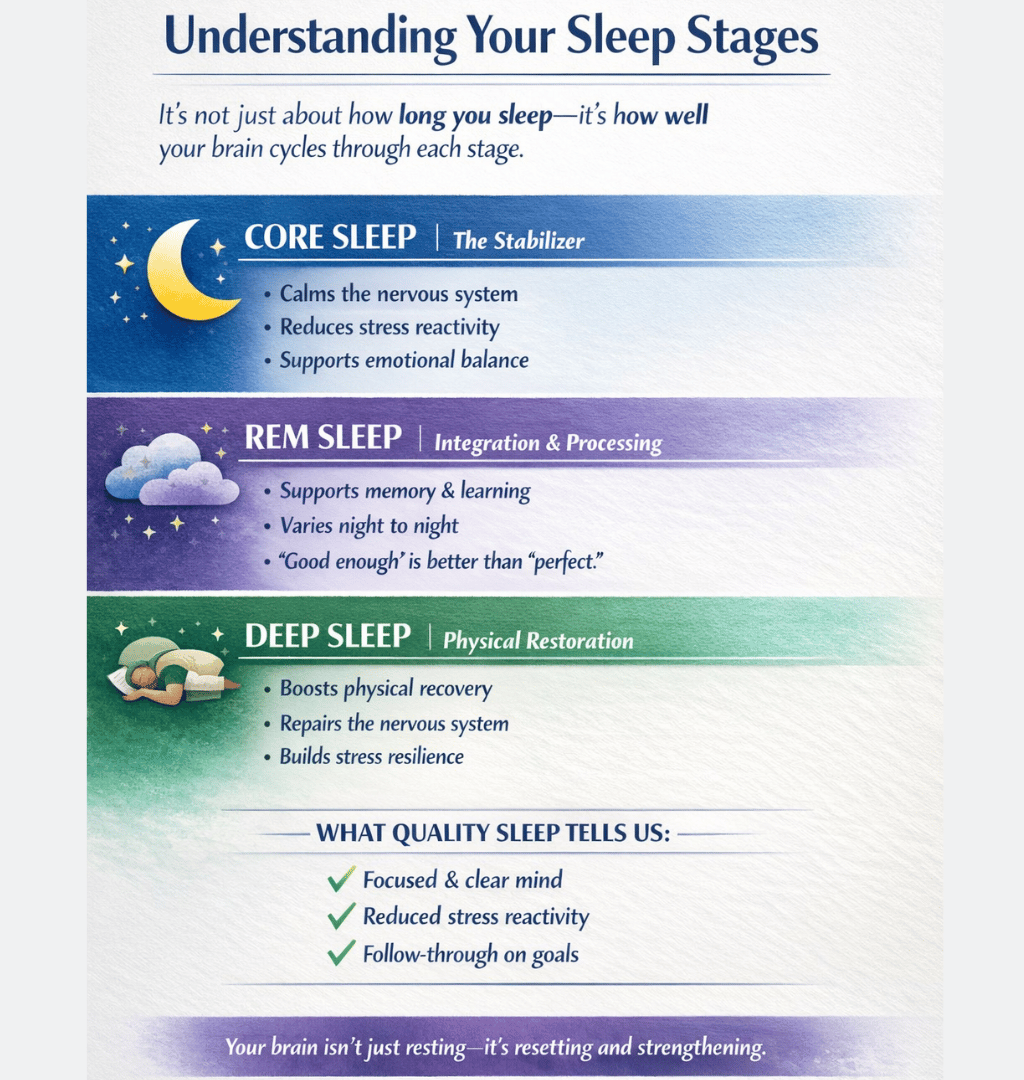
Core Sleep: The Nervous System Stabilizer
Core sleep makes up the largest portion of a well-regulated night. This stage is where the nervous system downshifts and stabilizes.
When core sleep is strong, people often notice:
Reduced stress reactivity
Less anticipatory anxiety
Improved emotional containment
Better ability to stay engaged with tasks
This is the stage most closely tied to waking up feeling calm and steady, even if the day ahead is demanding. Strong core sleep often explains why someone can feel mentally focused and productive — even if other stages fluctuate slightly.
REM Sleep: Integration, Not Perfection
REM sleep supports:
Memory consolidation
Emotional integration
Cognitive flexibility
REM is also the most variable stage. It naturally changes based on learning, stress load, novelty, and growth. A common misconception is that REM must hit a perfect percentage every night. In reality, during periods of:
Skill building
Cognitive consolidation
Increased productivity
REM may temporarily dip, without harming performance. If someone wakes up clear-headed, focused, and less reactive, that often signals efficient processing, not a deficit.
Deep Sleep: Physical Restoration & Resilience
Deep sleep supports:
Physical recovery
Nervous system repair
Stress resilience
Adequate deep sleep helps the body feel grounded and stable. Interestingly, people sometimes report feeling slower physically but sharper mentally after nights with solid deep sleep — a sign the system is prioritizing restoration and refinement rather than speed.
This is common during consolidation phases, when the brain is strengthening patterns instead of ramping up output.
What Healthy Sleep Architecture Looks Like
High-quality sleep often shows up as:
Minimal awake time overnight
Strong core sleep dominance
Adequate (not excessive) deep sleep
Normal night-to-night variation in REM
When this pattern is present, people tend to experience:
Better focus and follow-through
Reduced avoidance and procrastination
Less emotional overreaction
Greater capacity to stay engaged during a challenge
In other words, the brain isn’t just resting — it’s learning how to stay regulated under pressure.
The Bigger Picture
Sleep doesn’t have to be perfect to be powerful. What matters most is how sleep supports:
Calm decision-making
Emotional steadiness
Cognitive efficiency
Daily performance
When those improve, sleep is doing exactly what it’s supposed to do — even if the numbers don’t look textbook every single night.
Final Takeaway
Stop chasing “perfect sleep.”
Start paying attention to how your brain performs the next day.
If you’re calmer, clearer, and more capable of follow-through, your sleep architecture is working — and your nervous system is strengthening.
Disclaimer: The Brain Care Clinic provides coaching and peak performance brain training for wellness and self‑regulation. We are not licensed medical or mental health providers. Our services are not intended to diagnose or treat any mental health or medical condition. You acknowledge that you understand this and consent to receive these services as described.
We provide neurofeedback brain training and brain mapping services for clients throughout Orange County, California, Los Angeles County, CA and Riverside County, CA.
Custom options for in-home services are available. Please call for more details.
4000 MacArthur Blvd, Fl 6
(949) 257-2258
© 2020. All rights reserved.
Newport Beach, CA 92660