
Understanding Sleep Stages: What Light, Deep, and REM Sleep Actually Do
If you’ve ever wondered why you can sleep for hours and still wake up feeling tired, the answer often lies in how you’re sleeping, not just how long. In this blog, we break down the three main stages of sleep, light sleep, deep sleep, and REM, in simple, easy-to-understand terms. You’ll learn what each stage does, why each one matters, and how they work together to support energy, focus, emotional balance, and overall well-being. Understanding your sleep stages can help you make sense of common struggles such as brain fog, stress, low energy, and restless nights, and show you what truly restorative sleep is meant to feel like.
Jessica Novak
2/3/20266 min read
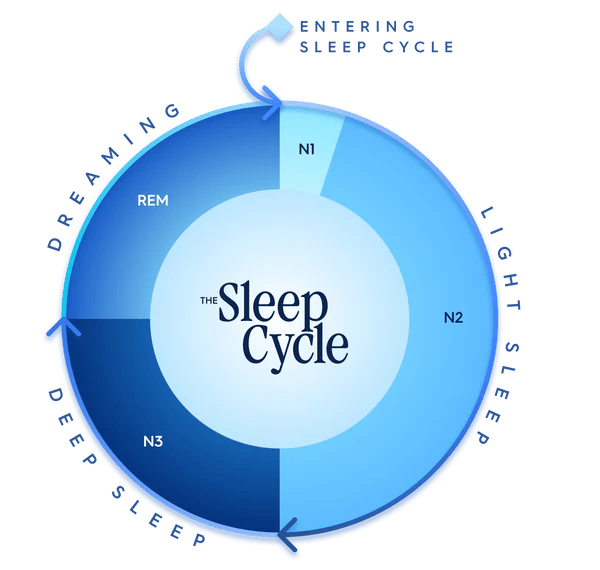
Not long ago, sleep was a bit of a mystery. You either felt rested, or you didn’t. Today, wearable technology has pulled back the curtain. Devices such as the Apple Watch and the Oura Ring now allow individuals to see how much time they spend in light, deep, and REM sleep each night.
While this data can be incredibly empowering, it also raises new questions. What do these sleep stages actually mean? Why do some nights show plenty of sleep but still leave you feeling tired, unfocused, or emotionally off? And how do these stages work together to support energy, focus, emotional balance, and overall well-being?
Understanding what each stage of sleep does and why each one matters can help turn sleep tracking data into meaningful insights. It can help guide what you eat, how you work out, and your evening routine to optimize them. When you know what your brain and body are trying to accomplish during the night, you can make better choices about sleep hygiene.
For most adults, healthy sleep architecture follows a general pattern: light sleep makes up the largest portion of the night, usually around 50–60% of total sleep; deep sleep typically accounts for about 10–20%; REM sleep usually falls around 20–25%; and awake or restless time is ideally minimal, often under 5–10%. These numbers are not meant to be interpreted rigidly from a single night of data, especially since wearable devices estimate sleep stages rather than measure them with the precision of a clinical sleep study. Instead, they are best used as trend markers over time. A single night of low, deep sleep or elevated awake time may reflect stress, travel, alcohol, late meals, intense exercise, hormonal changes, or an irregular schedule. However, when patterns repeat over several nights, the data can offer meaningful insight into how well the brain and body are cycling through restoration, emotional processing, and recovery.
Light Sleep: The Bridge That Holds Sleep Together
Light sleep accounts for the largest share of your sleep and helps the brain transition between wake, deep sleep, and REM (rapid eye movement) sleep. This stage helps the brain gradually disconnect from the external environment and shift into slower brainwave states, allowing it to rest without waking abruptly. When this stage is efficient, sleep remains continuous without waking up. It protects your brain from external noise and internal stress. When light sleep is inefficient, individuals wake easily or report feeling as if they "never slept deeply."
During light sleep, the brain decides what information is worth keeping and what can be discarded. This filtering of memory prepares the brain for deeper integration of learning in later stages. Healthy light sleep supports mental efficiency and next-day focus, like attention, reaction time, and mental stamina. Too little light sleep often shows up as distractibility, mental fatigue, or feeling "on edge" despite having enough hours of sleep.
When light sleep is unusually high, it indicates that the brain has not had sufficient REM or deep sleep. Instead, the brain continues to cycle through light sleep because it does not feel fully safe or settled enough to remain deeper for long, leaving the nervous system stuck in "monitoring mode."
For most adults, healthy sleep architecture follows a general pattern: light sleep makes up the largest portion of the night, usually around 50–60% of total sleep
Deep Sleep: The Foundation for Recovery and Energy
Deep sleep is the body's physiological repair and recovery stage. This stage covers tasks such as physical restoration and cellular repair, brain cleanup and toxin clearance, nervous system grounding, energy reset and motivation, and hormonal balance and metabolic support.
As the brain enters the restoration phase, energy reserves are replenished, and accumulated metabolic waste is cleared. Essentially, your body uses this time to repair and rebuild, including muscle recovery and tissue repair, helping it reset after daily wear and tear. If the brain spends enough time in deep sleep, individuals wake up feeling physically refreshed instead of stiff, heavy, or run-down. Think of deep sleep as the overnight cleanup crew.
Metabolic waste is the leftovers that cells produce when they use energy to function. Throughout the day, the brain produces normal byproducts from thinking, processing information, regulating emotions, and using energy, much like exhaust from a car or heat from a phone that’s been running all day. These byproducts include leftover proteins, chemical “exhaust” from energy use, and fragments from neurotransmitters that have done their job. Deep sleep is when the brain finally slows down enough to clear this buildup, allowing mental fog to lift, energy to reset, and thinking to feel lighter and clearer the next day. Without sufficient deep sleep, this cleanup process doesn’t fully complete, which often manifests as grogginess, brain fog, or a feeling of mental heaviness despite adequate hours of sleep. Now here is where it gets really interesting.
During deep sleep, the brain’s cells shrink slightly, creating space between cells. When this happens, cerebrospinal fluid (CSF) flows more freely between these spaces, moving alongside blood vessels and through channels lined with specialized glial cells that support brain cells. As CSF flows through these channels, it washes away energy byproducts, protein fragments, and leftover neurotransmitters. These materials are transported out of the brain and into the body’s waste pathways. When deep sleep is consistent, waste removal is efficient, maintaining brain health. When deep sleep is chronically disrupted, clearance becomes less efficient over time, compounding oxidative and inflammatory stress. Over time, this leads to slower processing speed, greater vulnerability to cognitive fatigue, and higher stress levels. Deep sleep should account for 13-23% of total sleep, or 1-2 hours per night (if sleeping 7-9 hours). Intense physical activity or exercise may increase deep sleep to facilitate further physiological repair.
Deep sleep typically accounts for about 10–20%.
REM Sleep: Emotional Balance and Mental Clarity
REM sleep is where the brain fine-tunes emotional balance and mental performance.
REM sleep is where the brain fine-tunes emotional balance and mental performance. During this stage, the brain processes experiences, integrates learning, and reduces the emotional intensity associated with memories and stress.
Every day you have conversations, feel emotions, react to stress, make decisions, and experience wins, losses, awkward moments, or surprises. These experiences do not disappear just because the day is over. Instead, the brain processes these experiences by replaying and organizing what happened, reducing the emotional intensity of these events, extracting useful meaning or lessons, and filing this organized data in a stable form.
Additionally, you learn new things every day. Whether it is a new skill, information in a conversation, a fact or concept, a mistake you made, or a pattern you noticed (consciously or unconsciously). By integrating learning, the brain determines what to retain, what to strengthen, what to connect to existing knowledge, and what to discard. In a sense, you are downloading files throughout the day, and the brain sorts those files into the proper folders while you sleep and removes duplicates. Without this step, information stays scattered and disorganized.
When the brain reduces the emotional intensity associated with memories and stress, it reactivates those experiences during REM sleep. During this time, the stress hormone norepinephrine drops dramatically compared to the real event. The body is relaxed, and the brain knows there is no real-world threat, creating a safe space for the memory to be reactivated without the full stress response. During this process, the brain retains factual memory, attenuates the emotional charge, reconnects it to a broader context, and integrates it into a more objective life narrative. In other words, instead of feeling that a similar event in the future is overwhelming or threatening, you can reassure yourself that it happened again; it wasn’t ideal, but it will be okay. This takes you from being triggered to being reminded, and instead of reacting, you respond. Without this process, individuals become hypersensitive and reactive, tending to ruminate or overthink.
Disrupted or fragmented REM sleep can lead to individuals who experience mood swings, elevated stress levels, racing thoughts, or difficulty concentrating, even after many hours of sleep.
REM sleep usually falls around 20–25%.
How the Stages Work Together
As you can see, each stage plays a vital role in our physical, mental, and emotional well-being. And when these sleep stages work in harmony together, that is when the real magic occurs.
Light sleep is the bridge between deep and REM sleep, providing stability and smooth transitions between the two and helping individuals remain asleep. Deep sleep restores energy and grounds the nervous system. REM sleep refines emotional balance and cognitive clarity.
If one stage is missing or inadequate, the other stages cannot fully complete their tasks. For example, deep sleep without REM may restore your physical energy, but leave emotional tension unresolved. REM without deep sleep may support a better mood, but still leave the body feeling exhausted. Balanced sleep architecture allows the brain and body to maintain connection, recover efficiently and sustainably, and sustain connection.
The Role of Neuroscience, Brain Coaching, and Neurofeedback
At The Brain Care Clinic, we view sleep as an active extension of the training process, not a separate event. Neuroscience brain coaching helps clients understand how their daily habits, stress patterns, and nervous system state influence their light, deep, and REM sleep stages. Neurofeedback training teaches the brain to downshift, supporting the brain in practicing more efficient regulation while awake, and healthy sleep architecture is where those gains are consolidated (fully encoded and retained). When the sleep stages are balanced, the brain is better positioned to strengthen and retain the progress made during neurofeedback training. In this way, neurofeedback and sleep work together as a coordinated system to support resilience, clarity, emotional balance, and long-term performance.
In today’s high-demand world, optimizing sleep and brain function is not a luxury; it is a foundational necessity for sustained performance, emotional resilience, and long-term well-being. Marriages love us, families adore us, and executives consider us their secret weapon.
Disclaimer: The Brain Care Clinic provides coaching and peak performance brain training for wellness and self‑regulation. We are not licensed medical or mental health providers. Our services are not intended to diagnose or treat any mental health or medical condition. You acknowledge that you understand this and consent to receive these services as described.
We provide neurofeedback brain training and brain mapping services for clients throughout Orange County, California, Los Angeles County, CA and Riverside County, CA.
Custom options for in-home services are available. Please call for more details.
4000 MacArthur Blvd, Fl 6
(949) 257-2258
© 2020. All rights reserved.
Newport Beach, CA 92660